Bluelight Gruop-Automatic Rescue Device
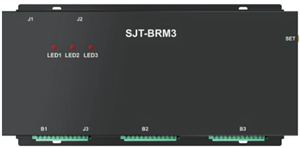
The core function of an elevator power outage Automatic Rescue Device is to automatically activate an emergency power system in the event of a sudden power outage or grid failure during elevator operation. This system safely moves the elevator car to the nearest floor level and opens both the car and landing doors, allowing trapped passengers to evacuate safely.Currently, Bluelight Group can provide two output voltage levels are available for rescue operations: single-phase AC220V and single-phase AC380V; and three grid voltage levels are applicable: three-phase 380V, three-phase 220V, and single-phase 220V. Please select the appropriate grid voltage level and rescue voltage level based on your elevator control cabinet system.
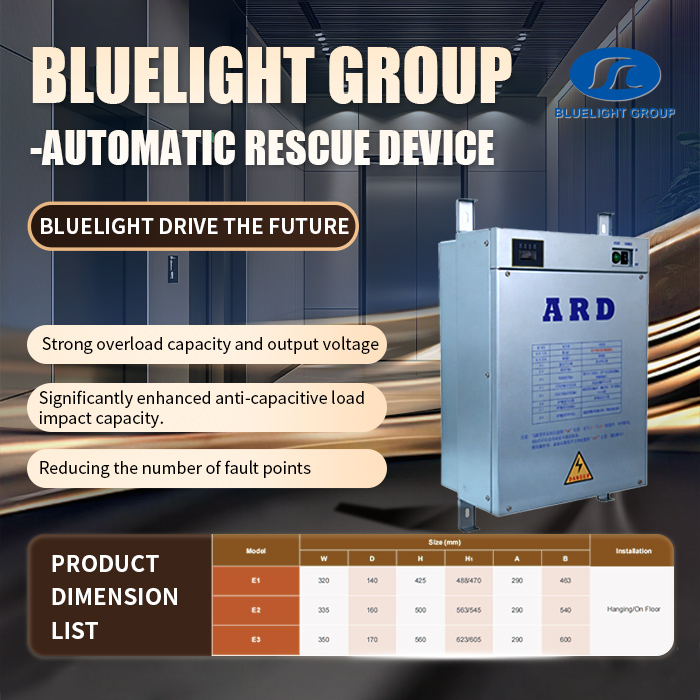
Ensuring Passenger Safety and Preventing Entrapment Risks
Elevators rely on grid power for normal operation. During a power outage, the elevator car will stop directly between floors, trapping passengers in a confined space. This can easily cause panic and may lead to physical discomfort due to prolonged waiting for rescue. This device intervenes quickly, allowing the elevator to precisely level and open its doors, fundamentally reducing the incidence of passenger entrapment.
Protecting Elevator Equipment and Reducing Damage from Malfunctions
If the elevator car is suspended between floors during a power outage, components such as the traction system and door operating system will be under stress. Prolonged static positioning can lead to component deformation or malfunction. After the rescue device levels the elevator car, it allows all elevator components to return to a safe, unloaded state, reducing equipment wear and tear.
Improving Elevator Operating Reliability and Reducing Rescue Costs
Elevators without this device require manual rescue after a power outage, which not only consumes the time and energy of property management or maintenance personnel but may also cause secondary malfunctions due to improper rescue operations. The self-rescue device enables unattended automatic rescue, significantly shortening rescue response time and reducing the cost and risks of manual rescue.
Compliance with Safety Standards
Currently, in many countries and regions, elevator safety standards require elevators in high-rise residential buildings, commercial complexes, hospitals, and other densely populated areas to be equipped with a power outage self-rescue device. This is one of the important indicators for elevator safety acceptance.
Features :
1. Most advanced technology enables longer-duration rescue operations: Equipped with advanced DC boost and full-bridge inverter circuit technology, it features high conversion efficiency and low power loss, thus supporting rescue operations for a much longer period than conventional devices.
2.Intelligent battery charge/discharge management for extended battery lifespan:
lConfigured charging power input circuit with under-voltage and over-voltage protection
lReal-time cyclic display of charging battery voltage and capacity for round-the-clock battery status monitoring
lSmart automatic switching among constant voltage charging, constant current charging, and trickle charging modes
lBattery low-voltage protection and output under-voltage protection effectively prevent battery over-discharge and significantly extend battery lifespan
3.Fully modular design for user-friendly operation:
lBuilt-in power source switching function eliminating the need for auxiliary circuits, enabling plug-and-play use
lQuick battery installation and removal for convenient on-site replacement
lDual output voltage options available: Single-phase AC 220V and AC 380V, which users can select based on specific project requirements